Infection Prevention and Control in Healthcare: A Practical Safety Guide
Infection prevention and control in healthcare combines risk assessment, standard precautions, hand hygiene, appropriate PPE, sharps safety, environmental controls and safe work practices to reduce occupational exposure and the transmission of infectious agents.
What Is Infection Prevention and Control in Healthcare?
Infection prevention and control in healthcare is a coordinated system of practices designed to reduce exposure to and transmission of infectious agents within healthcare environments.
Healthcare workers may encounter infectious hazards through patient contact, blood and body fluids, contaminated equipment, environmental surfaces, respiratory exposure, sharps and healthcare waste.
Effective infection prevention therefore depends on several protective layers working together rather than relying on a single measure.
Understand How Occupational Infection Exposure Can Occur
Healthcare personnel can encounter infectious agents through different exposure pathways depending on the work, environment and infectious hazard involved.
Blood & Body Fluids
Sharps injuries, splashes and contact with potentially infectious material can create occupational exposure.
Respiratory Exposure
Some infectious agents can spread through respiratory particles, requiring controls appropriate to the transmission pathway and activity.
Contact & Contamination
Hands, equipment, surfaces, textiles and other contaminated materials can contribute to transmission when controls are inadequate.
Base Infection Prevention Controls on Risk Assessment
Infection-prevention decisions should reflect the task, anticipated exposure and credible transmission pathways.
Risk assessment can consider the activity being performed, possible contact with infectious material, likelihood of splashes or aerosols, equipment involved and environmental conditions.
This approach helps healthcare organizations select controls appropriate to actual exposure rather than applying identical measures to every task.
Apply Standard Precautions During Healthcare Delivery
Standard precautions provide a foundation for infection prevention across patient-care environments.
They include practices such as hand hygiene, appropriate use of PPE, respiratory hygiene, safe injection practices, environmental cleaning and safe handling of potentially contaminated equipment and materials.
Healthcare personnel should apply the precautions appropriate to the anticipated exposure during the activity being performed.
Make Hand Hygiene a Core Infection Prevention Practice
Hands can contribute to the transfer of microorganisms between patients, healthcare workers, equipment and the surrounding environment.
Healthcare organizations should make appropriate hand-hygiene facilities and supplies accessible where care is delivered and ensure personnel understand when and how hand hygiene should be performed.
Glove use does not eliminate the need for appropriate hand hygiene.
Select PPE According to Anticipated Exposure
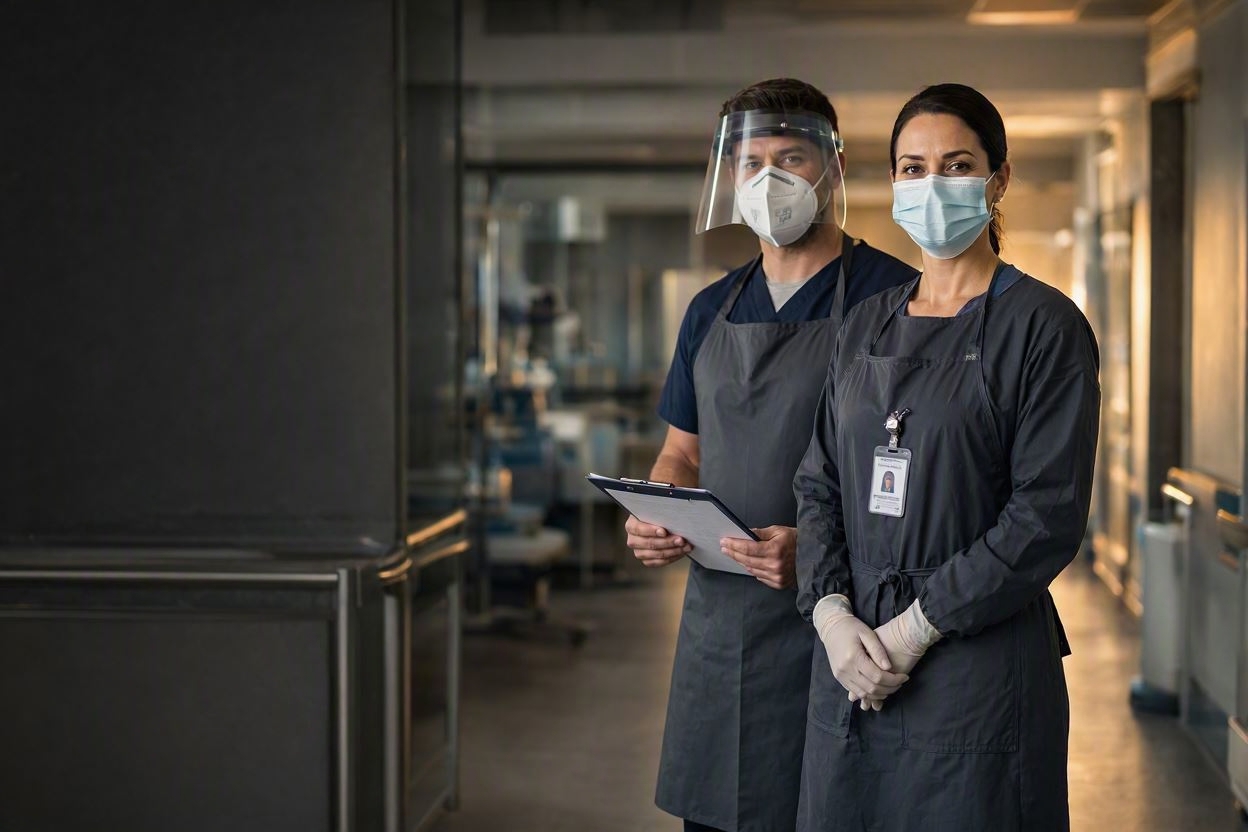
Healthcare PPE can include gloves, gowns or other protective clothing, masks, eye protection, face protection and respiratory protective equipment.
Selection should reflect the task and the type of exposure that can reasonably be anticipated.
Workers should understand how to put on, use, remove and dispose of or reprocess protective equipment without creating unnecessary contamination.
Distinguish Respiratory Protection From General Face Protection
Different protective devices serve different purposes. Where a respiratory hazard requires respiratory protective equipment, the selected device should be suitable for that hazard and the work being performed.
Respiratory protection should form part of a broader exposure-control approach that considers ventilation, work practices, training and other relevant measures.
Personnel should understand the limitations of the respiratory protection they are expected to use.
Prevent Needlestick and Sharps Exposure
Needles and other sharp medical devices can create both physical injury and occupational infection exposure.
Prevention should address device selection, safe handling, work practices and immediate disposal into suitable sharps containers.
Sharps containers should be positioned so that workers can dispose of devices without unnecessary handling or movement through the workplace.
Integrate Safe Injection Practices Into Infection Control
Injection and medication practices should prevent contamination and avoid unnecessary exposure of patients and healthcare personnel.
Personnel performing these activities should follow appropriate aseptic practices and established procedures for preparation, administration and disposal.
Equipment and supplies should be handled in ways that maintain their intended cleanliness or sterility and prevent cross-contamination.
Control Contamination in the Healthcare Environment
Environmental surfaces can become contaminated during healthcare activities and require cleaning and disinfection appropriate to their use and exposure.
Healthcare organizations should establish responsibilities, procedures, products and frequencies appropriate to the areas being cleaned.
High-touch surfaces and areas affected by contamination may require particular attention within the environmental cleaning program.
Manage Contaminated Patient-Care Equipment Safely
Reusable patient-care equipment can become contaminated and contribute to transmission when it is not handled and reprocessed appropriately.
Healthcare personnel should understand how contaminated equipment is transported, contained, cleaned, disinfected or sterilized according to its intended use and applicable procedures.
Clean and contaminated equipment should be managed in ways that reduce opportunities for cross-contamination.
Handle Healthcare Textiles Without Spreading Contamination
Used linen and textiles can become contaminated with biological material during patient care.
Handling arrangements should minimize unnecessary contact and reduce the possibility of dispersing contamination to personnel, surfaces or other materials.
Workers responsible for collection, transport and processing should understand the precautions applicable to their activities.
Manage Infectious Healthcare Waste Safely
Waste generated during healthcare can include contaminated materials, sharps and other items requiring controlled handling.
Appropriate segregation, containment, storage and internal transport help reduce exposure of clinical personnel, cleaners and waste handlers.
Waste-management controls should reflect the hazards associated with the material and applicable local requirements.
Include Respiratory Hygiene in Infection Prevention
Healthcare environments should include measures that reduce exposure to respiratory secretions and infectious respiratory particles where relevant.
Measures can include communication, appropriate source-control practices, hand hygiene, environmental arrangements and additional precautions based on the suspected or confirmed infection and mode of transmission.
Controls should reflect current risk rather than remain static when transmission conditions change.
Apply Additional Precautions When Standard Measures Are Not Enough
Some infectious hazards require additional controls beyond standard precautions because of their transmission characteristics.
Additional precautions can involve patient placement, enhanced PPE, respiratory protection, environmental measures or other controls appropriate to the transmission pathway.
Healthcare personnel should understand which additional measures apply to their role and when those measures are required.
Consider Ventilation in Respiratory Infection Control
Ventilation can form an important part of controlling airborne contaminants within healthcare environments.
The required approach depends on the facility, activity and respiratory hazard being managed.
Where specialized ventilation systems form part of infection-control arrangements, their operation and maintenance should receive appropriate technical oversight.
Prepare for Occupational Exposure Incidents
Healthcare organizations should establish clear arrangements for responding to occupational exposures such as sharps injuries, splashes and other contact with potentially infectious material.
Workers should know how to perform immediate first-response actions, report the event and obtain appropriate evaluation and follow-up.
Exposure events should also be reviewed to determine whether prevention measures need to be strengthened.
Connect Infection Prevention With Occupational Health
Protecting healthcare personnel from occupational infection requires coordination between infection-prevention activities and worker health arrangements.
Organizations should establish appropriate processes for occupational exposure management, work-related infection concerns and other worker-health matters according to applicable requirements and professional guidance.
Protecting the workforce supports both occupational safety and continuity of healthcare delivery.
Train Healthcare Personnel in Infection Prevention
Personnel should understand the infection-prevention practices relevant to their duties and exposure risks.
Training can address hand hygiene, PPE, sharps safety, environmental practices, equipment handling, exposure reporting and additional precautions relevant to the worker’s role.
Practical skills should be verified where safe performance depends on correct technique rather than knowledge alone.
Monitor Infection Prevention Practices
Healthcare organizations should verify whether important infection-prevention practices are being implemented consistently.
Monitoring can include observation, standardized audits, exposure information, environmental checks and other measures appropriate to the healthcare activities involved.
Findings should be used to provide feedback and improve systems rather than simply generate compliance statistics.
Use Workplace Inspections to Verify Infection Controls
Healthcare inspections can identify problems involving sharps disposal, PPE availability, environmental cleanliness, waste handling, equipment storage and other infection-prevention arrangements.
Inspection should examine actual workplace conditions rather than relying only on written procedures.
Significant findings should be corrected and followed through to confirm that the required improvement has been implemented.
Learn From Infection-Control Incidents and Near Misses
Occupational exposures and infection-control failures can reveal weaknesses in equipment, procedures, training, supervision or workplace design.
Investigation should identify contributing factors and determine why existing controls did not prevent or adequately limit the event.
Lessons should then be incorporated into relevant risk assessments, procedures, training and control measures.
Review Infection Controls When Healthcare Work Changes
New procedures, equipment, patient-care activities, facility arrangements and infectious hazards can alter exposure risks.
Relevant infection-prevention measures should be reviewed when significant changes affect the assumptions on which existing controls were based.
Healthcare organizations should also use new evidence and lessons from practice to improve established infection-control arrangements.
A Practical Infection Prevention and Control Framework
Effective infection prevention and control in healthcare connects exposure assessment, preventive controls, workforce competence and continual verification.
Assess
Identify infectious hazards, exposure pathways, affected personnel and the healthcare activities involved.
Control
Apply standard precautions and additional engineering, environmental, work-practice and protective measures as required.
Train
Ensure personnel understand the controls relevant to their roles and can correctly perform required infection-prevention practices.
Verify
Monitor implementation, investigate exposures and improve controls when conditions, evidence or healthcare activities change.
Common Infection Prevention and Control Mistakes
Inconsistent Basic Practices
Complex infection-control systems are weakened when foundational practices such as hand hygiene and safe equipment handling are inconsistent.
Overreliance on PPE
PPE is important, but it should work alongside appropriate engineering, environmental and work-practice controls.
Weak Verification
Written procedures provide limited protection when organizations do not verify how infection-prevention controls are applied in practice.
Infection Prevention and Control in Healthcare Requires Multiple Protective Layers
Effective infection prevention and control in healthcare combines standard precautions with risk-based measures appropriate to the infectious hazard and activity being performed.
Hand hygiene, sharps safety, environmental controls, safe equipment handling, appropriate PPE, worker training and exposure management should function as connected parts of a practical infection-prevention system.
Continue Your Healthcare Safety Learning
Explore IOSHQ resources covering infection prevention, occupational hazards, worker protection and practical healthcare safety management.