Hazardous Drugs and Chemical Safety in Healthcare: A Practical Guide
Hazardous drugs and chemical safety in healthcare requires systematic control of occupational exposure during receiving, preparation, use, administration, cleaning, transport, spill response and disposal.
What Is Hazardous Drugs and Chemical Safety in Healthcare?
Healthcare facilities use chemicals and medications that are essential to patient care but can create occupational hazards for workers when exposure is not adequately controlled.
Examples include hazardous drugs, cleaning and disinfecting products, sterilants, laboratory chemicals, anesthetic gases and other substances used throughout healthcare operations.
Effective chemical safety identifies hazardous substances, evaluates how workers can be exposed and applies controls appropriate to the substance, task and healthcare environment.
Recognize Chemical Hazards in Healthcare
Chemical exposure is not limited to laboratories or pharmacies. Hazardous substances can be encountered across clinical, diagnostic, cleaning, maintenance and support activities.
Hazardous Drugs
Some medications can create occupational health risks during receiving, preparation, administration, cleaning, waste handling and other activities.
Healthcare Chemicals
Disinfectants, sterilants, laboratory reagents and other chemicals can create inhalation, skin, eye and other exposure hazards.
Gases & Vapors
Anesthetic gases, chemical vapors and aerosols may require ventilation, capture systems or other controls to reduce worker exposure.
Identify Hazardous Drugs and Chemicals Before Exposure
Healthcare organizations should maintain a reliable method for identifying hazardous substances used or encountered in the workplace.
Hazard information may come from product labels, safety data, authoritative hazardous-drug lists, manufacturer information and applicable occupational safety requirements.
Identification should occur before a new substance enters routine use so that appropriate controls can be established in advance.
Assess Hazardous Drug and Chemical Exposure Risks
The presence of a hazardous substance does not describe the complete occupational risk. Assessment should examine how the substance is handled and how exposure could occur.
Relevant factors can include the substance and formulation, quantity, route of exposure, frequency and duration of handling, work practices and controls already in place.
The assessment should reflect facility-specific conditions and should be reviewed when drugs, chemicals, procedures or exposure controls change.
Understand How Healthcare Workers Can Be Exposed
Chemicals and hazardous drugs can enter the body through different occupational exposure pathways.
Depending on the substance and task, exposure may occur through inhalation, skin contact, eye contact, accidental ingestion or injection through a contaminated sharp.
Control measures should therefore be selected according to the credible exposure route rather than relying on a generic chemical-handling procedure.
Apply the Hierarchy of Controls to Healthcare Chemicals
Chemical safety should prioritize controls that reduce exposure at its source wherever practicable.
Elimination or substitution may remove or reduce some hazards. Engineering controls can isolate workers or capture contaminants, while administrative and work-practice controls support safer handling.
PPE provides an additional protective layer where exposure remains and should not automatically become the first or only control considered.
Reduce Chemical Hazards Where Safer Alternatives Are Suitable
Healthcare organizations should consider whether an unnecessary hazardous chemical can be eliminated or replaced with a less hazardous alternative that still achieves the required clinical, cleaning or technical function.
Substitution should be evaluated carefully because a replacement substance may introduce different hazards or require different controls.
Changes should therefore be assessed before implementation rather than assuming that a substitute is automatically safer in every respect.
Control Hazardous Substances at the Source
Engineering controls can reduce worker exposure by containing, isolating or capturing hazardous substances before they reach the breathing zone or work environment.
Depending on the activity, these controls may include appropriate ventilation, local exhaust, containment equipment, closed systems or specialized preparation environments.
Engineering controls should be correctly designed, operated, maintained and verified if worker protection depends on their performance.
Control Exposure Throughout the Hazardous Drug Lifecycle
Occupational exposure can occur at multiple stages of hazardous drug handling rather than only during preparation or administration.
Healthcare organizations should consider receiving, unpacking, storage, transport, preparation, administration, spill response, cleaning, handling of contaminated materials and disposal.
Clinical and non-clinical workers who may contact contaminated materials or surfaces should be included in the exposure assessment.
Manage Hazardous Drugs and Chemicals During Receiving
Exposure prevention begins when hazardous materials arrive at the healthcare facility.
Receiving personnel should be able to recognize relevant hazardous materials, identify damaged packages and follow established procedures when leakage, breakage or contamination is suspected.
Receiving arrangements should prevent damaged materials from being moved through the facility without appropriate control.
Store Hazardous Chemicals Safely
Storage arrangements should reflect the properties and compatibility of the chemicals involved.
Containers should remain appropriately identified, and storage areas should be organized to reduce accidental damage, incompatible mixing and uncontrolled access.
Healthcare facilities should also consider ventilation, spill containment and other storage controls required by the substances and applicable requirements.
Control Exposure During Hazardous Drug Preparation
Drug preparation can create exposure when hazardous material escapes through droplets, aerosols, leaks, contaminated surfaces or other pathways.
Preparation methods and engineering controls should be selected according to the drug, dosage form, manipulation required and applicable professional or regulatory requirements.
Personnel should understand the protective systems used in the preparation area and the actions required if containment is compromised.
Reduce Exposure During Hazardous Drug Administration
Healthcare workers can encounter hazardous drugs while connecting, administering, disconnecting or disposing of drug-delivery systems.
Safe administration procedures should reduce leakage, splashing, aerosol generation and unnecessary handling of contaminated components.
The required engineering controls, work practices and PPE should reflect the drug, delivery method and exposure potential of the task.
Control Exposure to Cleaning and Disinfecting Chemicals
Cleaning and disinfection products are essential in healthcare but can create occupational exposure through skin contact, splashes, vapors, aerosols or incompatible chemical mixing.
Workers should follow product-specific handling instructions and understand the ventilation, dilution, PPE and other controls required for the substances they use.
Chemicals should never be mixed unless the procedure and product information specifically establish that the combination is safe and intended.
Manage Exposure to Chemical Sterilants
Chemical sterilization processes may involve substances capable of causing significant occupational exposure if containment, ventilation or work practices are inadequate.
Workers involved in sterilization should understand the specific hazards of the chemicals and equipment used in their facility.
Engineering controls, leak prevention, maintenance, monitoring and PPE should be established according to the sterilization system and applicable requirements.
Control Chemical Hazards in Healthcare Laboratories
Healthcare laboratories may use reagents, solvents, preservatives, stains and other chemicals with hazardous properties.
Laboratory risk assessment should consider the quantities used, procedures performed, potential reactions, ventilation, storage and credible spill or exposure scenarios.
Personnel should have access to appropriate hazard information and understand the controls applicable to each laboratory activity.
Control Occupational Exposure to Waste Anesthetic Gases
Healthcare personnel working around anesthetic procedures may be exposed when gases escape from equipment, breathing systems or patient exhalation.
Appropriate equipment, scavenging, ventilation, leak prevention, maintenance and work practices can form part of the exposure-control system.
Facilities should assess the specific anesthetic agents, equipment and procedures they use rather than relying on general chemical precautions alone.
Select PPE for Hazardous Drug and Chemical Exposure
PPE should be selected according to the substance, task and anticipated route of exposure.
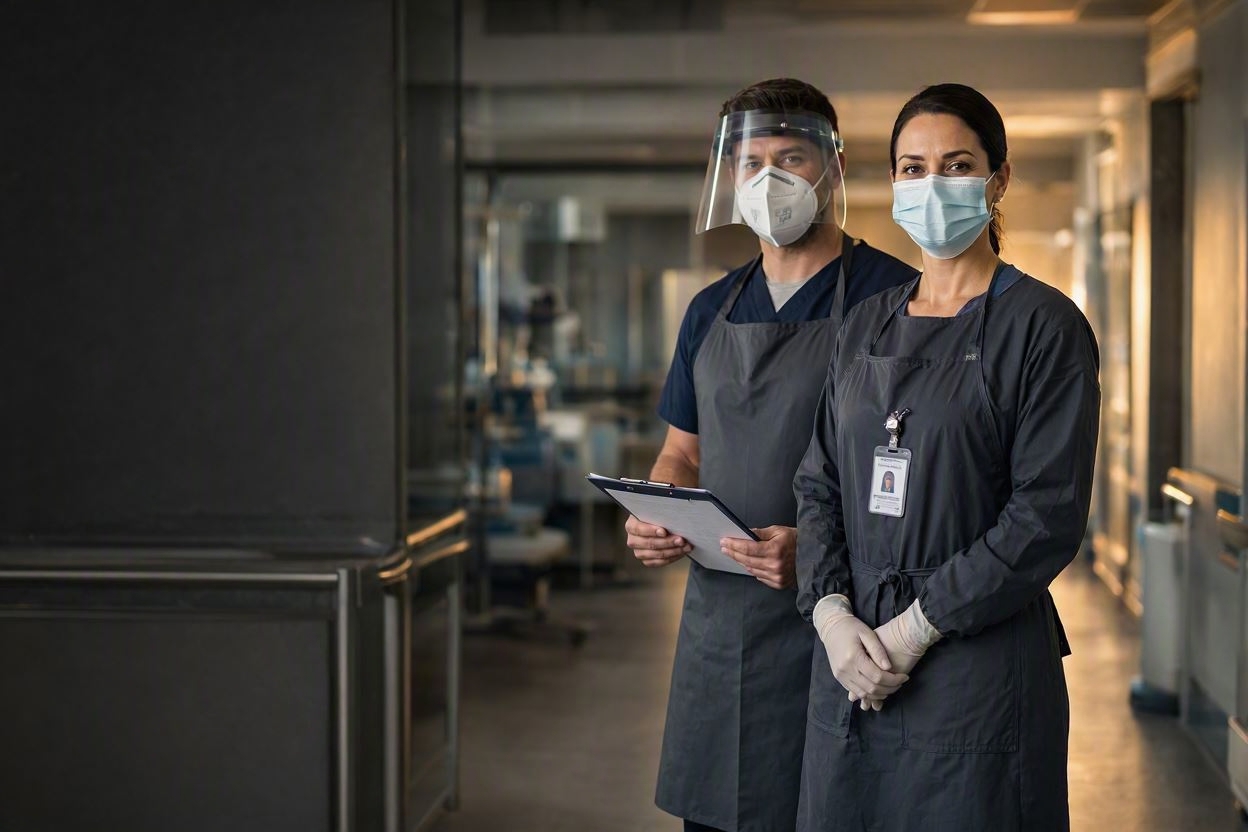
Depending on the activity, protection may include suitable gloves, protective clothing, eye and face protection or respiratory protective equipment.
Materials suitable for one healthcare hazard should not automatically be assumed to provide adequate protection against every chemical or hazardous drug.
Consider Contaminated Surfaces as an Exposure Pathway
Hazardous substances can contaminate work surfaces, equipment, containers and other materials even when no obvious spill is visible.
Workers may then contact contamination during preparation, administration, cleaning, maintenance or waste handling.
Cleaning and decontamination procedures should reflect the substance involved and the areas where contamination can reasonably occur.
Prepare for Hazardous Drug and Chemical Spills
Healthcare facilities should establish procedures for foreseeable spills before an incident occurs.
Workers should know how to isolate or control the area, obtain appropriate spill-response materials, use required PPE, report the event and obtain specialized assistance where necessary.
Spill response should reflect the chemical or drug involved rather than using one generic cleanup method for every hazardous substance.
Establish Procedures for Occupational Chemical Exposure
Healthcare workers should know how to respond when hazardous material contacts the skin or eyes, is inhaled or creates another occupational exposure.
Immediate actions and medical evaluation should follow the substance-specific hazard information, workplace procedures and qualified medical guidance.
Exposure incidents should also trigger review of the controls that were intended to prevent the event.
Manage Hazardous Drug and Chemical Waste Safely
Waste containing hazardous drugs or chemicals can expose workers after the original healthcare activity is complete.
Waste should be identified, segregated, contained, transported and disposed of according to its hazards and applicable local requirements.
Waste handlers and environmental-services personnel should be included in the safety system when their work can bring them into contact with hazardous materials.
Provide Clear Chemical Hazard Information
Workers need reliable information about the hazardous substances they use or may encounter.
Healthcare organizations should maintain appropriate labeling, safety information and workplace procedures consistent with the chemical-management system and legal requirements applicable in their jurisdiction.
Personnel should know where hazard information is located and how to use it when planning work or responding to an incident.
Train Healthcare Workers in Chemical Safety
Workers should understand the chemical and hazardous-drug risks relevant to their duties before performing work that can create exposure.
Training can address hazard recognition, safe handling, engineering controls, PPE, storage, spills, exposure response, waste and emergency procedures.
Training should reflect actual workplace substances and tasks rather than provide only generic chemical-safety information.
Use Worker Feedback to Identify Chemical Exposure Problems
Workers who regularly handle hazardous drugs and chemicals can identify leaks, difficult procedures, equipment limitations and other exposure concerns.
Healthcare organizations should provide practical methods for reporting problems and near misses before significant exposure occurs.
Worker feedback can also help evaluate whether controls remain practical during actual healthcare operations.
Include Chemical Safety in Healthcare Inspections
Workplace inspections can identify damaged containers, inappropriate storage, missing labels, unavailable spill materials, poor housekeeping and differences between established procedures and actual work.
Inspections should also consider whether engineering controls and PPE are available where exposure can occur.
Significant findings should be assigned for corrective action and followed through to completion.
Investigate Hazardous Drug and Chemical Exposures
Spills, leaks, occupational exposures and near misses can reveal weaknesses in equipment, procedures, training or facility controls.
Investigation should identify how the hazardous substance escaped its intended control and why existing safeguards did not prevent exposure.
Findings should be used to improve the risk assessment and strengthen relevant engineering, administrative, work-practice and PPE controls.
Review Chemical Risk When Healthcare Work Changes
New drugs, chemicals, equipment, procedures or changes in the volume of hazardous work can alter occupational exposure.
Relevant risk assessments and controls should be reviewed before significant changes become routine.
Review is also appropriate when exposure events, illnesses, near misses or workplace observations indicate that existing controls may not be functioning as intended.
A Practical Healthcare Chemical Safety Process
Effective hazardous drugs and chemical safety in healthcare connects hazard identification with exposure prevention, worker competence and continual verification.
Identify
Determine which hazardous drugs and chemicals are present, where they are used and who may encounter them.
Assess
Evaluate exposure routes, tasks, frequency, duration, quantities, existing safeguards and credible abnormal conditions.
Control
Apply elimination, substitution, engineering controls, safe work practices and suitable PPE according to the risk.
Verify
Inspect controls, investigate exposures, review changes and strengthen the system when weaknesses are identified.
Common Healthcare Chemical Safety Mistakes
Relying Only on PPE
PPE is important but should not replace feasible elimination, substitution, containment, ventilation or other source controls.
Ignoring the Full Lifecycle
Exposure can occur during receiving, transport, cleaning and waste handling as well as during preparation or clinical use.
Generic Chemical Controls
Different chemicals and hazardous drugs require controls appropriate to their properties, exposure routes and handling conditions.
Hazardous Drugs and Chemical Safety in Healthcare Requires Exposure Control at Every Stage
Hazardous drugs and chemical safety in healthcare should address the complete pathway from receiving and storage through preparation, use, cleaning, spill response and disposal.
Effective protection combines facility-specific risk assessment, source controls, safe work practices, appropriate PPE, worker training and continual review whenever substances, procedures or workplace conditions change.
Continue Your Healthcare Safety Learning
Explore IOSHQ resources covering healthcare chemical hazards, occupational exposure prevention, PPE and practical worker protection.